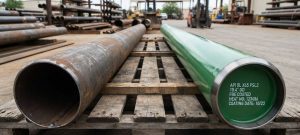
When purchasing steel pipe for construction, piling, casing, road boring, or underground utility work, it is important to understand the difference between API 5L X65, ASTM A252 Grade 2, and ASTM A252 Grade 3.
These specifications can sometimes appear similar on paper or even look identical when the pipe is sitting in a steel yard. However, they were developed for different applications and have different mechanical and manufacturing requirements.
For contractors, engineers, utility contractors, foundation companies, and steel pipe buyers in Canada, understanding these differences can help avoid costly material substitutions and ensure the pipe selected matches the project requirements.
API 5L X65 vs A252 Grade 2 and Grade 3 at a Glance
The biggest difference is the specification’s intended application and minimum mechanical properties.
| Pipe Specification | Typical Application | Minimum Yield Strength | Minimum Tensile Strength |
| ASTM A252 Grade 2 | Pipe piling / foundations | 35 ksi (240 MPa) | 60 ksi (415 MPa) |
| ASTM A252 Grade 3 | Pipe piling / foundations | 45 ksi (310 MPa) | 66 ksi (455 MPa) |
| API 5L X65 | Line pipe; can also be specified for certain casing applications | 65 ksi (448 MPa) | 77 ksi (531 MPa) |
The numbers immediately show that API 5L X65 has considerably higher minimum yield strength than either A252 Grade 2 or Grade 3.
But higher strength does not automatically mean that X65 is an acceptable replacement for A252 pipe.
The complete material specification, project requirements, dimensions, testing, welding requirements, and engineering design all need to be considered.
What Is ASTM A252 Pipe?
ASTM A252 is a specification specifically associated with steel pipe piles.
A252 pipe is commonly used in foundation construction where steel pipe is driven or installed into the ground and acts as a structural element.
Typical applications include:
- Pipe piles
- Foundation piling
- Structural foundations
- Marine construction
- Bridge foundations
- Building foundations
- Deep foundation systems
A252 is available in Grade 1, Grade 2, and Grade 3, although Grade 2 and Grade 3 are particularly common in construction applications.
ASTM A252 Grade 2
A252 Grade 2 has a minimum yield strength of approximately 35 ksi (240 MPa) and a minimum tensile strength of 60 ksi (415 MPa).
ASTM A252 Grade 3
A252 Grade 3 increases the minimum yield strength to approximately 45 ksi (310 MPa) and the minimum tensile strength to 66 ksi (455 MPa).
That makes Grade 3 stronger than Grade 2, but both remain within the A252 pipe-pile specification.
What Is API 5L X65 Pipe?
API 5L is the American Petroleum Institute specification for line pipe.
API describes API Spec 5L as a standard covering the manufacture of seamless and welded steel line pipe, including requirements for materials, manufacturing processes, inspection, testing, marking, and traceability. The current API 5L standard is the 47th edition, published in 2026.
The X65 designation refers to a high-strength grade within API 5L.
The “65” corresponds to a minimum yield strength level of approximately 65 ksi.
That puts X65 substantially above A252 Grade 2 and Grade 3 in minimum yield strength.
However, API 5L X65 was developed as a line-pipe material, primarily for applications involving the transportation of fluids.
That distinction is important when considering X65 for construction applications.
Can API 5L X65 Be Used for Casing?
Yes — API 5L pipe can be used for certain casing applications when it is specified and approved for that application.
This is particularly relevant to contractors working in underground construction, utility installation, and trenchless construction.
API documentation states that API 5L pipe may be ordered as casing in accordance with API 5C6.
This does not mean every piece of API 5L X65 automatically becomes suitable casing.
The project still needs to establish the required:
- Outside diameter
- Wall thickness
- Grade
- Pipe length
- Joint design
- Welding requirements
- Material testing
- Installation method
- Design loads
- Required documentation
The important distinction is between the material’s capability and the project’s specification.
A high-strength X65 pipe may be an excellent option for a particular casing application, but the engineer or project specification ultimately determines whether it is acceptable.
API 5L X65 for Road Boring and Casing
One of the applications where higher-strength steel pipe can be useful is road boring and other trenchless construction projects.
Road boring is commonly used when a contractor needs to install utilities underneath an existing road, highway, railway, or other obstruction without excavating the entire surface.
Depending on the installation method, steel casing can be installed to provide a protective passage for utilities.
Applications can include:
- Road crossings
- Highway crossings
- Railway crossings
- Utility crossings
- Watermain installations
- Sewer installations
- Gas and utility projects
- Trenchless construction
- Jack-and-bore projects
- Horizontal boring applications
For these projects, the casing can be subjected to significant forces during installation.
The pipe may need to withstand combinations of axial loading, external loading, handling forces, installation stresses, and other project-specific loads.
This is one reason high-strength pipe such as API 5L X65 can be considered for certain casing applications.
The important point is that the pipe needs to be designed and specified for the actual installation conditions.
Simply choosing X65 because it has a higher yield strength than A252 Grade 3 does not, by itself, establish that it is the correct casing.
Why X65 Can Be Attractive for Road-Bore Applications
The relatively high minimum yield strength of X65 can provide an advantage where the project requires a higher-strength steel pipe.
For example, compare:
A252 Grade 3: 45 ksi minimum yield strength
API 5L X65: 65 ksi minimum yield strength
That is a difference of 20 ksi in minimum specified yield strength.
Depending on the engineering design, the higher-strength material can provide additional material capacity without necessarily requiring the same increase in wall thickness.
However, this is an engineering consideration rather than a blanket rule.
A casing’s performance depends on more than yield strength.
Diameter, wall thickness, unsupported length, installation method, soil conditions, external loads, connections, and buckling can all affect the design.
A252 Grade 3 vs API 5L X65 for Casing
This is where contractors and buyers need to be careful.
A252 Grade 3 and API 5L X65 are not equivalent specifications.
A252 Grade 3 is specifically associated with pipe piles.
API 5L X65 is a high-strength line-pipe grade.
A project may specify either material depending on the intended application and engineering requirements.
For example, a foundation project may specifically call for ASTM A252 Grade 3 pipe piles.
A trenchless road-crossing project may instead specify a particular diameter and wall thickness of API 5L X65 or another casing-grade pipe.
Even though X65 has higher minimum yield strength, it should not simply be substituted into an A252 application without approval.
Likewise, A252 Grade 3 should not automatically be substituted for X65 simply because both are steel pipe.
Why Pipe Wall Thickness Matters
When discussing casing pipe, it is easy to focus too heavily on the grade.
The wall thickness can be just as important.
Consider two pipes:
- 24″ OD × 0.500″ wall
- 24″ OD × 0.750″ wall
Even if they were manufactured from the same grade of steel, they would not have the same structural properties.
Wall thickness affects:
- Section properties
- Bending resistance
- Axial capacity
- Buckling resistance
- Handling strength
- Installation performance
- Overall weight
For road-bore casing, the correct combination of diameter, wall thickness, material grade, and installation method needs to be established for the specific project.
API 5L X65 and Welding
Welding is another reason the complete material specification matters.
API 5L X65 is a higher-strength steel than A252 Grade 2 or Grade 3, so the welding procedure should be appropriate for the actual material being used.
For casing and road-boring applications, contractors may need to join multiple pipe sections together before or during installation.
The project may therefore have requirements for:
- Welding procedure qualification
- Welder qualification
- Preheat and interpass temperatures
- Filler metal
- Joint preparation
- Inspection
- Nondestructive testing
The exact requirements depend on the project specifications and applicable codes and standards.
The takeaway is simple:
Do not assume that a higher-strength pipe can automatically be welded using the same procedure as a lower-grade structural pipe.
API 5L X65 vs A252: Don’t Compare Grade Alone
One of the most common mistakes when comparing steel pipe is looking at the grade and ignoring the specification.
For example:
“X65 is stronger than A252 Grade 3, so X65 must be better.”
That conclusion is too simplistic.
The specifications exist for different purposes.
A252 is a pipe-pile specification.
API 5L is a line-pipe specification.
A project engineer may have requirements that involve much more than the material’s yield strength.
The correct comparison should consider:
- Material specification
- Grade
- Outside diameter
- Wall thickness
- Manufacturing method
- Mechanical properties
- Chemical composition
- Testing
- Welding requirements
- Project design requirements
- Installation method
- Required certifications
What About API 5L X65 Used as Structural Pipe?
This is another area where terminology can cause confusion.
A piece of API 5L X65 is still manufactured and certified to API 5L unless it has also been certified to another applicable specification.
It should not simply be marketed as “structural pipe” because it is physically being used in a structural application.
If a contractor needs X65 for a casing or road-boring application, the project documents should identify the required specification and grade.
If a project permits alternative materials, the engineer or owner should approve the substitution.
What Is Dual-Certified Pipe?
Dual-certified pipe can be particularly useful for construction projects.
A pipe may be manufactured and tested to meet the requirements of more than one specification.
This can give contractors greater flexibility when a project allows multiple material specifications.
However, buyers should verify the actual mill test report rather than relying on a supplier’s verbal description.
The MTR should identify the applicable specification, grade, chemical and mechanical properties, and other required information.
Documentation matters.
API 5L X65 for Underground Construction
The combination of high strength and availability in larger pipe sizes makes API 5L X65 potentially useful in certain underground construction applications.
Depending on the project requirements, applications may include:
Road Crossings
Steel casing can be installed beneath roads and highways to provide a protected pathway for utilities.
Railway Crossings
Railway crossings can require engineered casing systems that account for installation and loading conditions.
Utility Crossings
Steel casing can be used to protect utility installations beneath roads and other obstacles.
Jack-and-Bore Projects
Casing pipe is often installed as part of trenchless construction methods where the pipe is pushed, jacked, or otherwise advanced through the ground.
Horizontal Boring
Depending on the boring method and project design, high-strength steel pipe may be specified as casing.
The specific application determines the required pipe dimensions and material properties.
Ontario Construction Projects: Why the Specification Matters
For Ontario contractors, the exact project specification should always be checked before substituting pipe.
Ontario regulations demonstrate that casing requirements can be tied to specific material standards. For example, Ontario’s well-construction regulations identify API Specification 5L among the standards that can apply to certain steel casing, while also identifying ASTM A252 and ASTM A500 for specified casing applications.
That is a good example of why the phrase “steel casing” is not specific enough.
The application, dimensions, material specification, and applicable requirements all matter.
How to Choose Between A252 Grade 3 and API 5L X65
The decision should start with the project documents.
If the project calls for pipe piles:
Look for the specified ASTM A252 grade, diameter, wall thickness, and required testing.
If the project calls for road-bore casing:
Look for the specified casing material, diameter, wall thickness, installation method, and design requirements.
If the project allows substitutions:
Have the proposed material reviewed and approved by the engineer or project authority before purchasing or installing it.
If you’re buying surplus or secondary pipe:
Review the mill test report and material markings carefully.
Do not assume that a pipe described as “X65 equivalent” or “A252 equivalent” actually meets the required specification.
API 5L X65 vs A252 Grade 2 vs A252 Grade 3: The Bottom Line
API 5L X65, ASTM A252 Grade 2, and ASTM A252 Grade 3 are all steel pipe products, but they are not interchangeable simply because they have similar dimensions or can perform similar physical functions.
The key differences are:
- A252 Grade 2 — pipe-pile specification with a minimum yield strength of approximately 35 ksi.
- A252 Grade 3 — pipe-pile specification with a minimum yield strength of approximately 45 ksi.
- API 5L X65 — high-strength line-pipe grade with a minimum yield strength of approximately 65 ksi.
API 5L pipe can also be ordered for casing applications under API 5C6, making API 5L X65 relevant to certain underground and trenchless construction applications.
For road boring and casing projects, X65 can be an attractive material when the project is designed and specified for it. Its higher minimum yield strength can provide additional material capacity, but the correct pipe still depends on diameter, wall thickness, installation method, loading, welding requirements, and engineering approval.
The strongest pipe isn’t automatically the right pipe. The right pipe is the one that meets the project’s engineering requirements and specified material standard.
Need Steel Pipe for Your Next Construction Project?
Whether you’re sourcing API 5L X65, ASTM A252 Grade 3, or other structural and casing pipe, having the correct material specification and documentation is critical.
Our team at Interpipe Inc. supplies steel pipe to contractors and construction companies throughout Canada and can help you identify the appropriate material based on your project’s requirements.
Contact Interpipe Inc. to discuss your pipe requirements, available sizes, wall thicknesses, grades, and mill test documentation.